
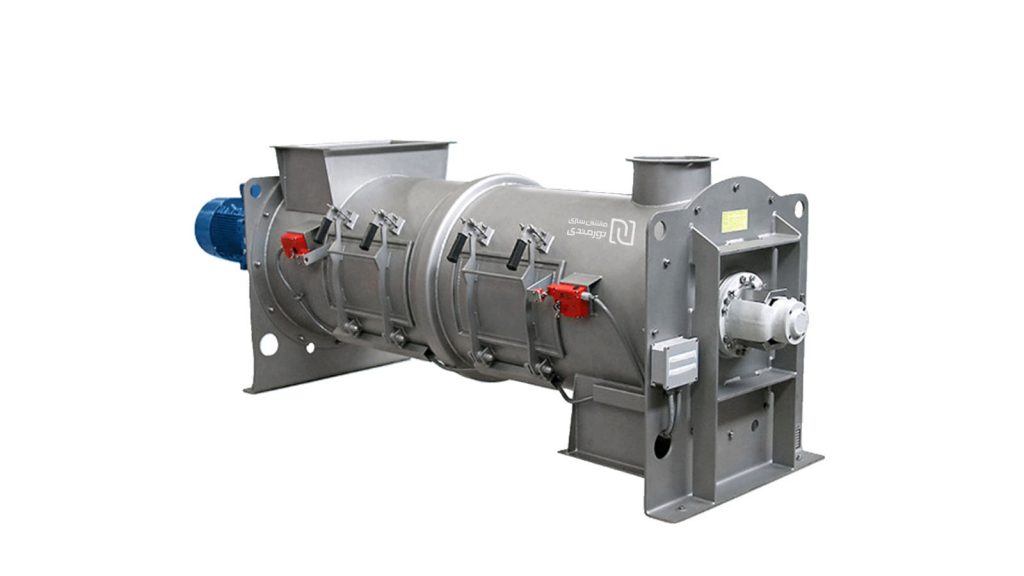


Horizontal Mixer
Mixers are machines used for mixing various types of materials. Among all types of industrial mixers, horizontal mixers are the most commonly used, especially for mixing powdery materials. However, different horizontal mixers are designed according to the type and nature of the material being mixed. For example, if the material is corrosive, the screw should be made of stainless steel to resist corrosion and prevent wear over time. The specially designed shape and rotation speed of a horizontal mixer create centrifugal movement, which disperses the materials three-dimensionally, allowing them to fully integrate. As a result, materials with different particle sizes and densities are mixed with high precision.
Types of Horizontal Mixers
Horizontal mixers can be categorized based on the type of blade, the number of main shafts, and the shape of the tank into two main types:
Horizontal Ribbon Blender Mixers
Horizontal Feed Mixers
Ribbon Blender:
This machine is used to mix several types of powders in specified proportions, resulting in an entirely uniform and homogeneous blend. It is also used in the food industry for mixing materials such as instant coffee, gelatin powder, pepper, cinnamon, turmeric, coffee, baking soda, as well as chemical and pharmaceutical substances.
Applications of Horizontal Mixers:
Horizontal mixers have numerous applications in different industries, comprising the soy protein industry, baking industry, animal husbandry and poultry industries, flour and grain industries, chocolate, cake, and biscuit industries, confectionery, sauces, dairy products, industrial sweets, and cheese-making. The aim of using horizontal mixers is to improve the uniform distribution of different materials, diminish the time required for mixing, guarantee effective movement of food materials inside the mixer, and increase the final product quality.
Horizontal Feed Mixer:
These mixers are commonly used in large livestock farms. Usually, these machines are made portable so they can be easily transported by a tractor. However, it is possible to custom-make horizontal mixers in both fixed and mobile versions.
Fixed Horizontal Mixer
The fixed horizontal mixer is used in the livestock industry for mixing fodder and feed. This device helps improve animal nutrition and increase feeding efficiency. Fixed horizontal mixers are usually made with changeable capacities, and the most proper mixer can be selected according to the size of the farm and the number of animals.
Mobile Horizontal Mixer:
Mobile horizontal mixers are essential tools in animal husbandry, used for feeding livestock by mixing different types of fodder. These tools are designed to be easily movable, allowing them to be transported to the livestock feeding area.
Structure of Horizontal Mixers:
- Mixer tank made of sturdy steel
- Screw (shape and material depend on the order specifications)
- Motogen electric motor
- Mixer shaft
Advantages of Using a Horizontal Mixer
- High mixing power for creating a homogeneous and uniform blend
- Available in various capacities consistent with customer requirements
- High efficiency and speed in mixing materials
- Suitable for use in chemical and pharmaceutical industries
- Easy maintenance and repair (when a part breaks, it can be easily repaired or replaced)
- Comes with a warranty and after-sales service
What is the Difference Between Horizontal and Vertical Mixers?
A common question often asked by phone or in person is, “What are the differences between vertical and horizontal mixers?”
- If you overfill a horizontal reel mixer, the mixture won’t blend; the drum will just spin. In some feed formulas, overfilling can break a chain or bend the lower screw. If you overfill a vertical mixer, it will simply spill out from the top and will almost have the same mixing effect as if it hadn’t been overfilled.
- You cannot place long-stemmed hay in a horizontal mixer. Some people ask if you can use a chopper first to cut the bale, but typically, the hay is still too long for a horizontal mixer. You can place a full round bale of hay in a vertical mixer and it will grind it. You need at least a 500-cubic-foot vertical mixer to handle a 5×6 round bale; otherwise, some of it will spill out.
- In a horizontal feed mixer, the order of adding ingredients doesn’t matter much. In a vertical mixer, you should place fluffy materials first and heavy materials last.
- A horizontal mixer has more moving parts than a vertical mixer.
- A horizontal mixer requires less horsepower and discharges faster than a vertical mixer.
- A vertical mixer has one or two gearboxes depending on the screw and drive shaft. A horizontal feed mixer has many chains and moving parts.
- Generally, the mixing in a vertical mixer is better and offers a more consistent blend

