

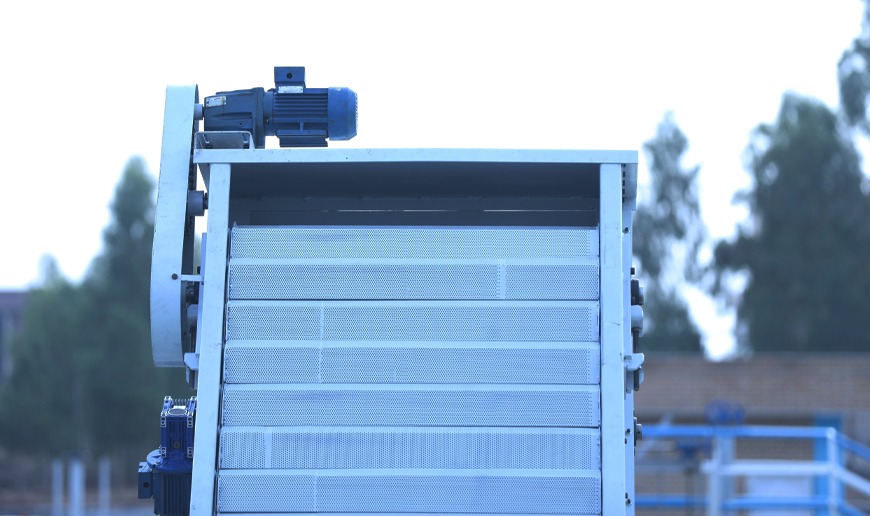

Fine Screen
The Fine Screen is an essential component in wastewater treatment systems designed to prevent large debris and particles from entering the treatment basins. Constructed from mesh or bar screens, the fine screen is installed in the wastewater flow path and typically has apertures ranging from 1.5 to 6 mm.
Applications of Fine Screen
Municipal and Industrial Wastewater Treatment: Screening at the inlet of treatment units to remove debris.
Cooling Water Systems: Screening intake water for cooling systems in refineries.
Water Treatment Plants: Removing debris from incoming water from rivers, lakes, and other sources.
Pulp and Textile Industries
Leather and Dyeing Industries
Food Processing
Slaughterhouses and Meat Processing Plants
Key Technical and Economic Benefits
Reduction of Equipment Wear: Minimizes damage to rotating equipment caused by abrasive particles.
Improved Sludge Quality: Enhances the quality of sludge entering the sludge processing section.
Reduced Blockage: Prevents clogging in sludge transfer lines.
Customizable Design: Can be designed to suit various flow rates.
Simple Maintenance: The system requires minimal maintenance due to its straightforward design.
Optimized Sludge Capacity: Prevents solid materials from occupying valuable sludge tank capacity.
Operation of the Fine Screen
This device operates 24/7 in a filtration process. When the water level drops below the maximum, the device stops, during which the filter screen becomes blocked, causing the water level to rise. Once the water reaches its highest level, the device resumes operation. It continues to separate solids from the wastewater until the water level falls to its lowest point, and this cycle repeats continuously.
Types of Fine Screens
Fine screens come in four primary types:
Fixed Wire Screen
Rotary Wire Screen
Moving Belt Screen
Step Screen
Key Point: Due to the small openings in fine screens, manual cleaning is not feasible, making mechanical cleaning the only option for maintaining them.
Even with fine screens installed at the entrance of a wastewater treatment plant, some debris chiefly plastic pieces and fibrous materials can still enter the sludge, potentially causing significant disruptions to the operation of essential sludge processing equipment. These particles can compromise the functionality of pumps, heat exchangers, mixers, and dewatering systems. Frequent blockages in pumps and valves within the sludge section, caused by hair, fibers, and small debris (such as wood chips, paper, and plastic), present a major challenge in wastewater treatment facilities. Such blockages not only lead to repeated interruptions in the sludge processing line and disrupt sludge disposal processes but also accelerate the wear and tear of equipment and valves. Hair and fibers often form clumps and fat balls. Therefore, it is vital to remove these harmful particles from the system before they can interfere with sludge processing and related equipment.
Fine screens are effective in removing these destructive particles, whether they are floating or submerged.
Design Parameters
The width and angle of the mechanical fine screen depend on the model and the channel width. It can be installed at angles of 60°, 75°, or 85°. For maximum efficiency, a 75° angle is recommended as it allows for higher flow rates and better solid removal. The screen moves solids out of the channel at a rate of approximately 0.03 m/s. The maximum removal of solid materials by a mechanical bar screen depends on the model and installation angle. The screen can operate in either a continuous or intermittent mode. However, intermittent operation is preferred, as it can improve the capture of solid materials.

